
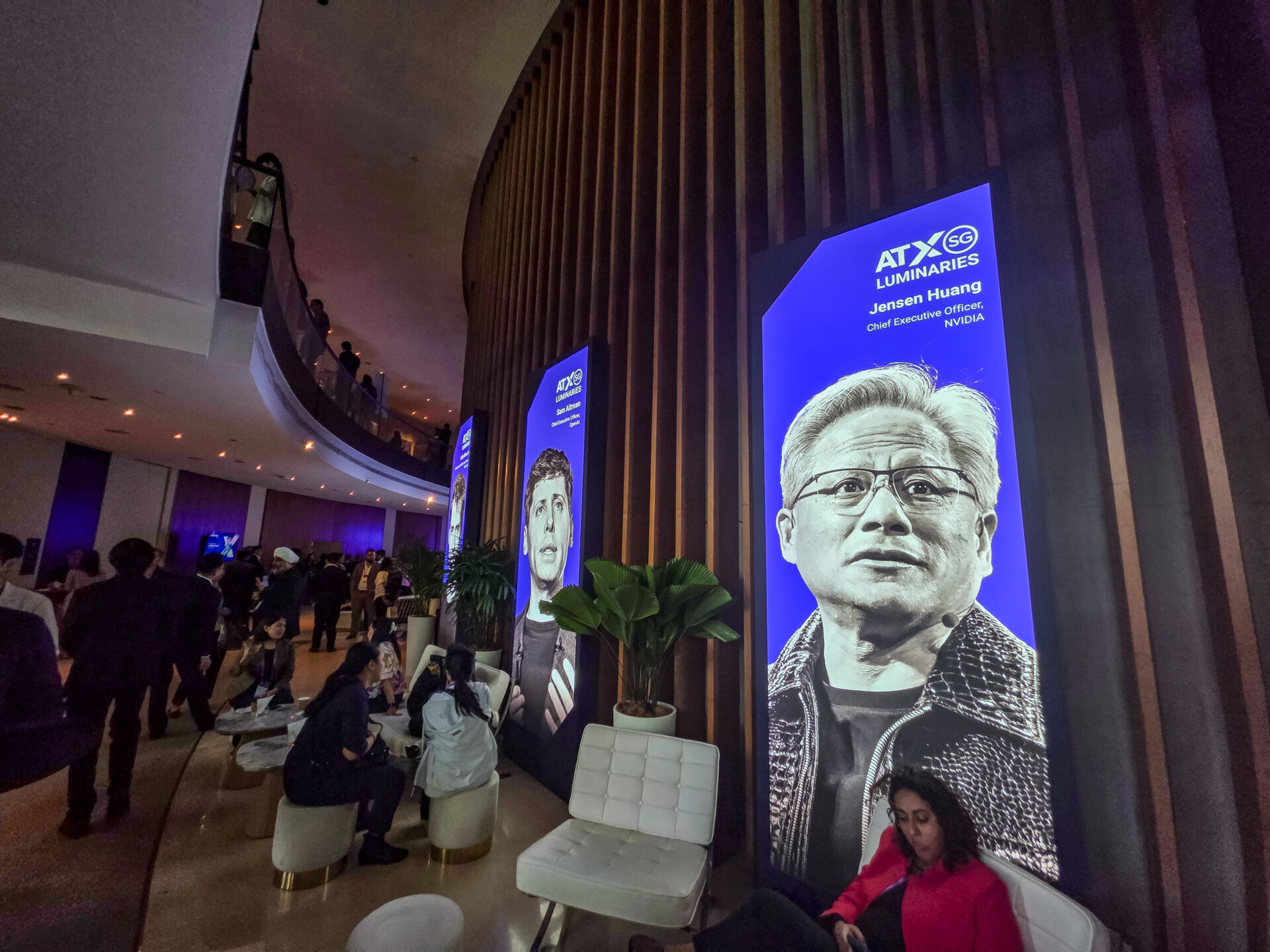
There he is, eyes staring into the future, with a microphone ready to amplify the latest gospel on what AI innovation awaits the world.
Jensen Huang, in a new shiny crocodile-leather jacket, greets visitors to Singapore’s ATxSummit this week not in person but in a larger-than-life poster that lauds the head honcho of Nvidia as a luminary.
Next to him is a poster of OpenAI chief executive Sam Altman, casting an imposing eye over those who come to the halls of Capella, a glitzy hotel in the Sentosa resort island. These luminaries, fortunately, do not include another bigwig in the shape of Mark Zuckerberg.
His company Meta fired 8,000 staff, including 100 in Singapore, at around 4am yesterday, hours before the doors opened for ATxSummit, Singapore’s big yearly huddle of AI experts, economists and other movers and shakers.
Like a growing number of tech firms, Meta is casting out employees and using the money saved to plough into more AI hardware. Yes, to buy those chips made by Nvidia, which just reported record revenues of US$81.6 billion in the past quarter.
It’s a good thing Standard Chartered Bank’s CEO Bill Winters isn’t recognised as a luminary at ATxSummit as well. The bank is set to fire 8,000 employees, including “lower-value human capital”.
Instead, one other luminary lauded by ATxSummit, which is organised by the Infocomm Media Development Authority of Singapore, is Singapore’s DBS chief executive Tan Su Shan.
She, unlike her fellow bank CEO or Mark Zuckerberg, has at least been talking up the importance of getting employees ready for AI instead of simply firing them to cut cost or fund AI investments.
On their own, these posters might seem a lot to read into an event that usually is just another gathering of the technorati in one of the world’s most advanced AI economies.
The two days of presentations and discussions by industry experts are often illuminating, especially talks on the guardrails needed to rein in AI and the type of real-world wins that are helping AI make a real difference to businesses.
Yet, there is an inevitable awkwardness that any outsider not involved in the AI bubble economy would feel by walking into this lush location surrounded by greenery.
Consider the advice to young people, offered by some of the speakers at the event, to be adaptable and have a good attitude to learn.
It’s well meaning yet can also be grating to the thousands who have lost their jobs not because they haven’t learnt AI or tried to be resilient but because their company sacrificed them to boost its share price. Reskilling wouldn’t have saved these jobs.
Outside these halls and across the bridge from this island paradise, news headlines reflect the daily challenges Singapore faces with growing frequency. Technology disruption is one; rising costs in the city-state are another.
This week alone, familar names Gardenia and H&M both said they were moving operations out of Singapore to the region.
AI has nothing to do with them but as people and businesses feel the squeeze here, Singapore’s technology and political leaders will find it increasingly tough to sell AI as a force for good. It doesn’t help when they see billionaires making all the money, sometimes at their expense.
And this is for a country that may have done as much as any to uplift its citizens. All this while, even before this AI disruption, Singapore’s government agencies have matched people to real jobs after reskilling and retraining, working closely with the industry to make things work.
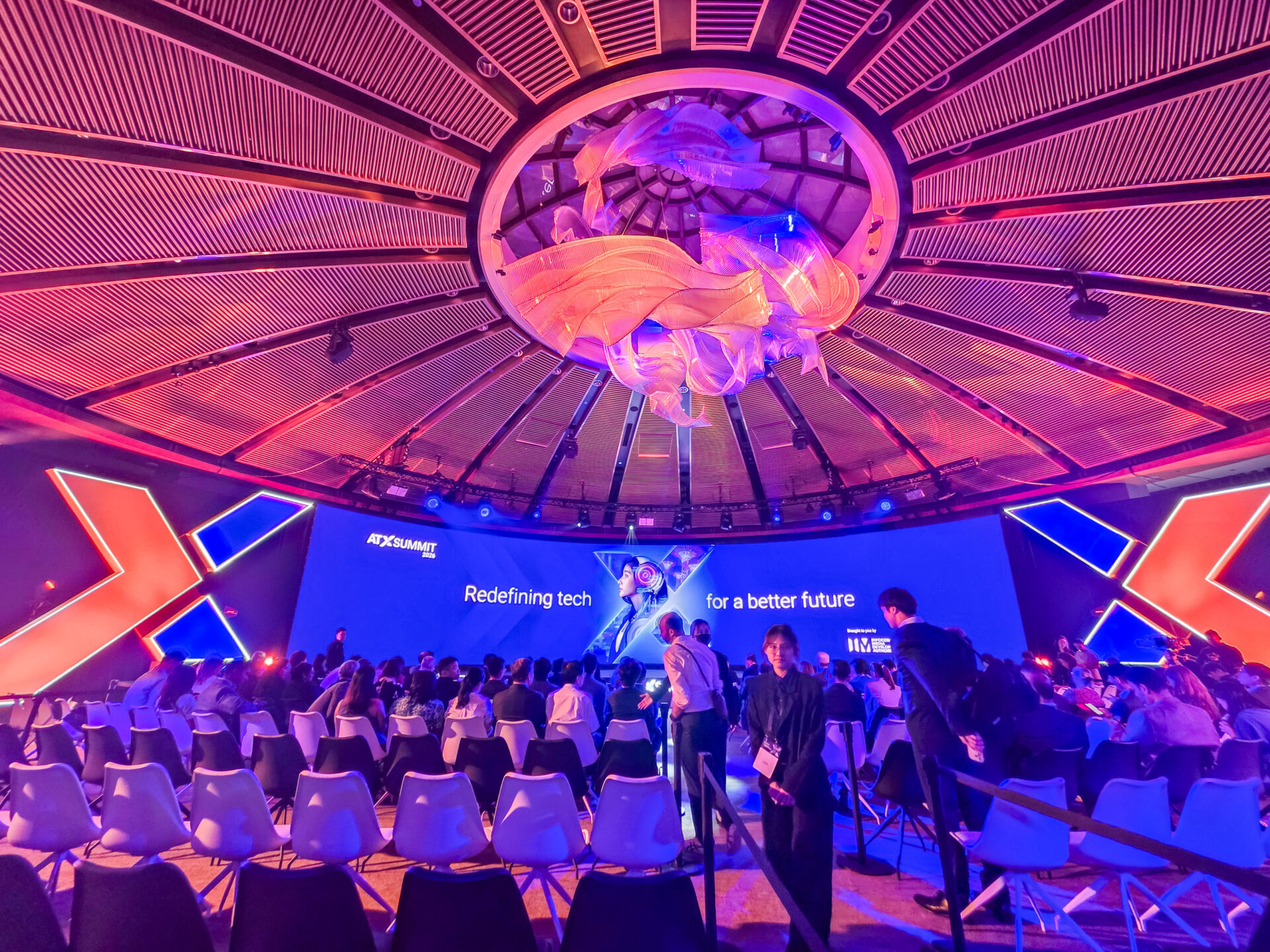
At the summit this year, Nvidia said it would launch a Singapore hub to focus on embodied AI and efficient AI computing. That brings high-paying jobs to the Republic.
The government also inked deals yesterday with Google and OpenAI (which is investing S$300 million in Singapore) to further develop the AI ecosystem in the country. By being at the forefront, Singapore should generate better job prospects for its citizens.
The strategy, as government leaders will say, is not to position the city-state as the place to develop frontier AI models or to base huge data centres, but make it a location for real-world tests and deployments of AI.
Doing this means Singapore will be important to the application of the technologies, where the path to monetisation is theoretically shorter.
Jobs, too, should come once people get themselves properly upskilled with the latest AI tools to work in the 10,000 firms expected to come here to expand AI usage. These, you hope, don’t follow what Meta and Standard Chartered have done lately.
What’s heartening to hear is how clear-eyed some Singapore companies are in championing job resdesign, rather than simply cutting staff for short-term gain.
Singtel, for example, is going to have AI agents in its workforce, with many entry-level jobs once carried out by fresh graduates now automated by AI, said its Singapore chief executive Ng Tian Chong.
This means new hires from school will just have to quickly get up to speed by having hands-on experience through internships, for example, to be ready to jump into the deeper end, he noted.
Even though parts of the company will be flatter with fewer layers, there will always be a human in the loop for qualities such as judgement and empathy, he added, in a panel discussion today.
To be clear, few people know how this disruption will pan out. Ask anyone at the summit today and they will say there is no way to ensure AI will end up benefitting employees more than harming their livelihoods.
The ups and downs will be tough, as Singapore looks to strike a balance with a technology that many believe is making societies less equal.
As a reminder of the challenge that economies around the world face, World Bank president Ajay Banga told the summit audience today that 1.2 billion young people will be in the job market in the next 15 years but only 400 million jobs will be created.
Asked how AI can be used to create jobs instead of cutting costs, he said: “You cannot convince the private sector to do something that does not meet the needs of their investors.”
“If you show them that this AI can enable a better return for their investors, that is the only way they will focus on – using it in a way that is sensible,” he added.
“You have got to find a way to give them reason to believe that return comes in the right way by doing the right things with technology,” he stressed.