

It’s taken four years.
Four years to get the Wi-Fi 802.11n specifications finally agreed upon. Four years ago, Airgo Networks (now part of Qualcomm) was a trailblazer in MIMO (Multiple Input Multiple Output), which is the technology behind 802.11n. By using multiple antennas in MIMO, the data throughput and range can be increased.
I remember that 802.11n — then in its draft incarnation — was one of the freshest news to hit the scene four years back when I was still a trade journalist.
Fast forward to today. What was supposed to be a two-year ratification process took four, and 802.11n was finally officially ratified this year in September 2009. Ratification means that if your device is labeled 802.11n compliant, it will work with any other 802.11n device, regardless of vendor.
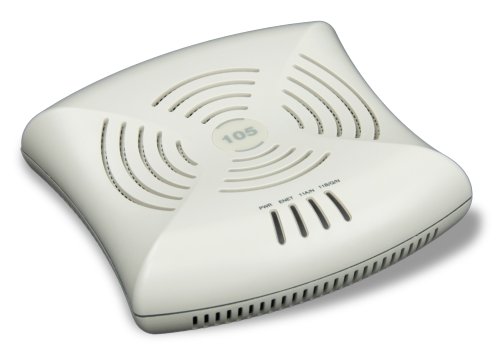
All of this is history. Except that I got reminded about this when I met Aruba Networks last week at a press event, where they were in town to tout their newest enterprise 802.11n access point device: The AP-105, which is going for US$695 (S$962).
According to Aruba Networks, they have the cheapest 802.11n appliances when compared to other enterprise networking vendors like Cisco or HP ProCurve.
That the price has gone south is entirely expected. Ratification of the 802.11n spec means commoditization of the technology, which in turn means all kinds of cheap China-made 802.11n devices should soon flood the market. This is a good thing for businesses and consumers, as the price point for deployment of 802.11n Wi-Fi has gone down and should go down even further.
Albert Tay, general manager for Aruba Networks for South Asia and India, believes that the market “is ripe” for 802.11n deployment, and this is something the enterprise wireless switching company is pushing hard in its marketing. They believe that 802.11n can replace much of the Ethernet cabling (Cat 5e typically) required in facilities.
Why lay so much cable when your 802.11n wireless Wi-Fi speeds are equally as fast (if not faster)? Unless you’re going Gigabit Ethernet, 802.11n does make for a sound argument. And even physical cabling companies like Belden are evolving wireless products, which underscores the threat that high speed Wi-Fi is to cabling. Belden acquired Trapeze Networks, another old player in the wireless switching space, last year in July 2008.
That mid-tier wireless companies like Aruba Networks are coming out to do media and channel marketing pushes now means that they believe there is money in the market. It will be interesting to see how the market plays out.




Speed and cost are important, I agree.
But, capacity is also a requirement. Without radio density equal to the multiport Ethernet throughput of a switch, you are still sharing a smaller amount of bandwidth with Aruba’s solution of one AP. They would have us place AP everywhere to get the density, meaning even more devices to install, configure and manage.
The Xirrus array delivers the .11n standard along with a multiradio configuration (up to 16) matching the capacity of a switch.
A couple other things the Array delivers out of the box that Aruba doesn’t – spectrum analysis (layer 1 managment is improtant with wired too), radio assurance (resolving radio lock automoatically is a good thing), IDS/IPS, non-blocking/line speed encryption and decryption……
While Aruba may claim to have the cheapest enterprise 802.11n Access Point on the market, the HP ProCurve MSM 410 AP retails at US $649 … $44 cheaper than the Aruba AP-105.
HP ProCurve offers intelligent 802.11n wireless Access Points from our single radio n/a/b/g (MSM410) to our dual n/a/b/g + a/b/g Access Point (MSM422). The HP ProCurve MSM APs are advanced wireless access points designed to provide consistent, easy to manage connectivity to expand your existing network. Maintain your network without interruption with fast, always-on access points that reduce bottlenecks and network complexity by determining where data needs to go across the network. Supporting a/b/g and n capabilities, the MSM APs provides complete wireless coverage for greater reliability and connectivity. The HP ProCurve MSM Access Points require a single Power over Ethernet (PoE) cable drop and are IEEE802.3af compliant. All HP ProCurve MSM APs support a plug-and-play automatic configuration and ongoing central control by HP ProCurve MSM Controllers for the highest degree of configurability and ease of management. The HP ProCurve Access Points can also work in autonomous mode.
It also comes with a true Lifetime warranty for as long as you own the product.. rather than a limited lifetime warranty, which according to Aruba Lifetime Warranty FAQ states, “Aruba Lifetime Warranty coverage remains in place for as long as you own the product, up to five years following Aruba announcement of end‐of‐sale of that product.”
For more details, go to http://www.procurve.com/products/wireless/HP_ProCurve_802_11n_MultiService_Access_Point_Series/overview.htm
Disclaimer: I am a Technical Consultant for HP