In partnership with Ready Server
Across Southeast Asia, local software developers, digital agencies and tech-focused businesses have been rushing to integrate AI into their everyday work.
From automated customer support chatbots to agentic tools that manage complex server tasks, the push to harness large language models (LLMs) has become increasingly common in the region.
Yet, building with AI has hit a familiar wall – money. Developers and IT teams prototyping new features quickly find themselves burning through cash on public AI application programming interfaces (APIs).

While individual API token prices seem tiny on paper, real-world usage paints a different picture, as many businesses are finding out. The more applications shift from basic chat prompts to autonomous AI agents, the worse the problem gets.
How much worse? Well, AI inference costs per agentic workflow will grow more than fivefold through 2028, according to research firm Gartner.
The alternative hosting setup in the cloud world has proven just as frustrating. Allocating a virtual GPU to a Virtual Private Server (VPS) often locks down pricey hardware resources 24/7.
For small engineering teams or independent developers whose applications only run periodic inference jobs, paying a high monthly fee for an idle graphics processing unit (GPU) is a quick way to waste IT budget.
To solve this dilemma, Singapore-based infrastructure provider Ready Server is launching ReadyServer LLM API in October, bring a shared-GPU inference service to its VPS customers.
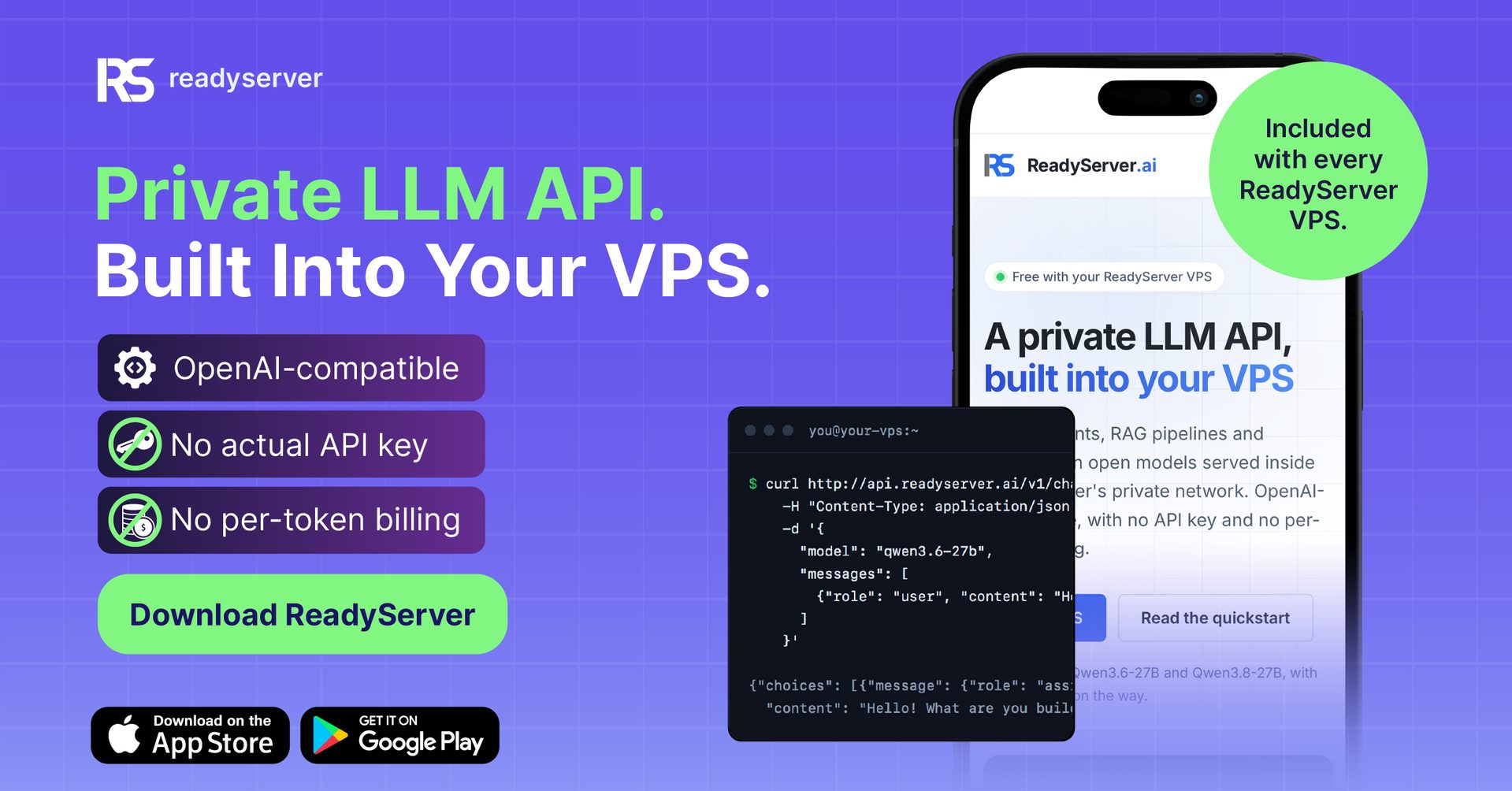
Instead of forcing users to buy expensive dedicated virtual GPUs that sit idle half the day, Ready Server is hosting a centralised, high-performance GPU cluster that VPS users can query on demand at no extra cost.
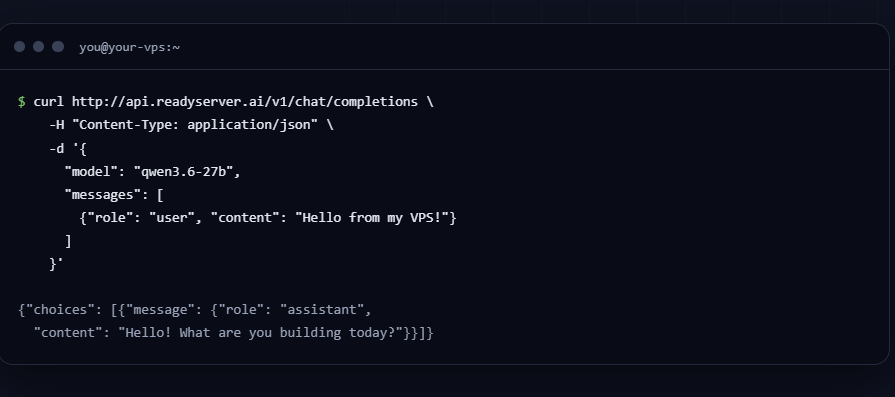
Under this setup, developers do not need to lock down isolated hardware on their individual VPS instances. Instead, they make direct HTTP API requests over an internal network from their VPS directly to Ready Server’s central GPU server.
Because the endpoint mirrors standard OpenAI API syntax, developers can point existing code bases, command-line tools, or frameworks to local open-weights models like Qwen3.6-27B-FP8 and Qwen3.8-27B-FP8 without rewriting their application logic.
For a developer, sending an API call from their local VPS will enable them to access the AI capabilities they desire. And that’s without requiring local hardware, complicated command-line setups, or monthly token bills from third-party API providers.
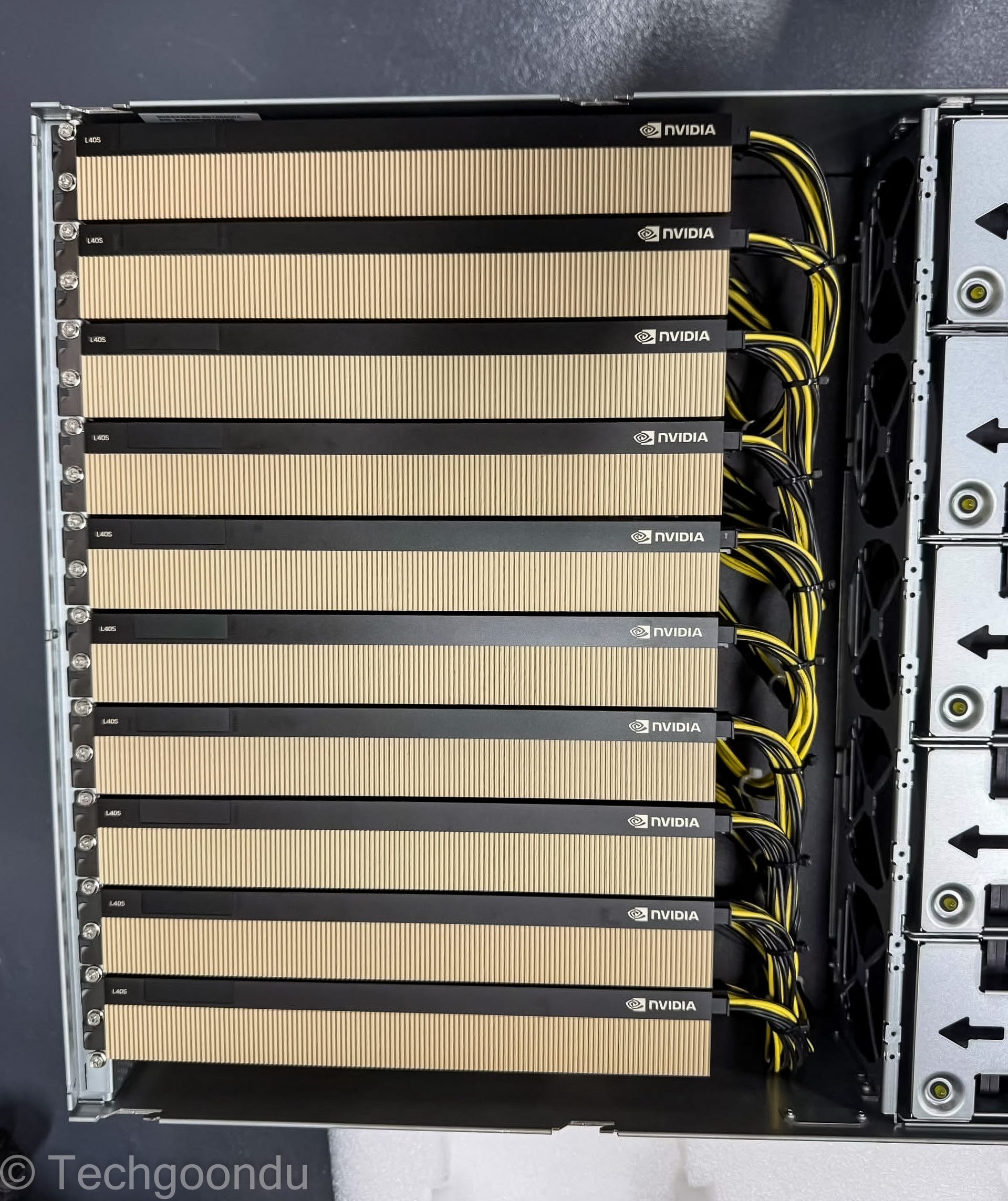
To keep latency low and eliminate compute bottlenecks, Ready Server has backed its developer preview with AI-capable enterprise hardware.
Rather than relying on massive, power-hungry training rigs built around chips like the Nvidia H200, Ready Server’s infrastructure uses GPUs specifically optimised for rapid inference workloads.
The cluster combines AI accelerators with workstation-grade GPUs, offering enough VRAM to comfortably manage large context windows and concurrent incoming queries.
By serving open-weight models like Qwen, Ready Server ensures swift token output and steady performance, capable of serving concurrent user requests without lag.
The ReadyServer LLM API setup allows developers to deploy local terminal helpers. From there, the agent can handle server administration tasks, execute firewall security checks, write code scripts, or perform Web searches without straining local server resources.
Beyond performance and ease of use, Ready Server’s local GPU model focusses on two critical priorities for many businesses in Singapore – data control and predictable monthly costs.
Crucially, Ready Server operates strictly as an infrastructure host, not an AI data aggregator. Prompts, internal corporate data, document extractions, and proprietary code passed to the server remain private.
Ready Server will not use customer data to train or fine-tune public AI models. Furthermore, because API traffic moves over Ready Server’s isolated internal network between the VPS and the GPU cluster, sensitive data doesn’t leave the host environment.
On the financial front, Ready Server replaces unpredictable token-based billing with a predictable shared-hosting cost structure. VPS customers enjoy fair-usage internal network bandwidth for GPU requests, eliminating the fear of surprise end-of-month invoice spikes.
This setup gives engineering teams a risk-free environment to test, iterate, and launch AI-powered applications or client demos on standard VPS hosting.
Instead of burning budget on public cloud tokens during prototyping, developers can refine their software locally and scale up seamlessly when production traffic demands it.
Find out how you can run your AI workloads on Ready Server’s AI service out soon in a developer preview here.