From the angry to the sarcastic, Singapore’s frustrated train commuters have taken to Facebook pages – real and fake – to vent their unhappiness at the massive train disruption yesterday. Thousands of commuters were left stranded when train services on segments of the North-South line were disrupted during yesterday’s evening peak travelling hours.
Folks on one particular train, trapped in a tunnel between stations, resorted to smashing a fire extinguisher at a window to get fresh air, after power came off and the air conditioning went offline. They then hiked to the nearest station in a dimly-lit tunnel, during the latest but one of the most serious disruptions to the city’s train services.
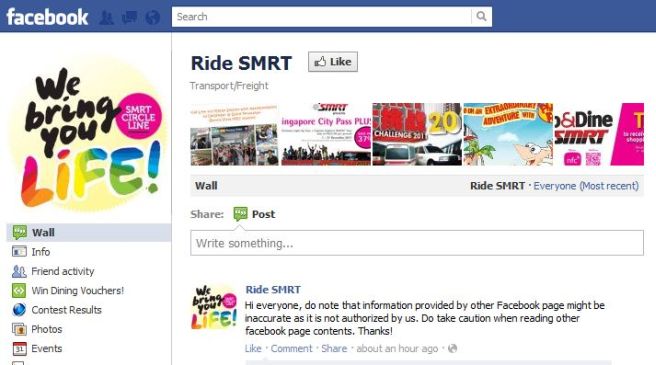
Today, Internet users were fast to vent their anger at SMRT on the social media space, whether this was through a fake SMRT Facebook page set up by online pranksters or on SMRT’s own page. …
Twitter may already possess a large portion of the pie serving up bite-sized pieces of information, but a bunch of developers based in Singapore is taking square aim at the micro-blogging service with a location-based twist.
Like Twitter, the app lets users feature – or feecha – an event or an object that’s close to him/her, which friends of that user can discover. Unlike Twitter, however, these feechas are all visualised on a map, and are colour-coded based on popularity.
It is currently possible to add your location to a tweet, but Twitter treats that as a secondary and optional feature. Feecha seeks to highlight that very feature and make it central to the app’s experience. …
Money, cost and price were the most talked about issues on social media during the Singapore general elections 2011.
So says Singapore social media insights start-up JamiQ and data visualization company Swarm.
They drew this conclusion based off the data collected via their real-time visualization of the GE 2011 twitter streams, which can be found at ge.swarm.is.
A total of 188,768 tweets were collected for the project between the dissolution of the parliament on 19th April 2011 to voting day 7th May 2011 based on the keywords “Singapore elections” and hashtag #sgelections.
Of these, there were 77,913 unique tweets and 110,855 retweets. These were spread across 11,069 unique users.
Social media has the power to change the world. It allows people with the same shared beliefs to come together and marshal grassroot support for causes.
It could be used to organize protests, campaign for beliefs, or even used to promote giving back to community.
One such great example of the latter is Twestival, a global phenomenon that started two years earlier in 2009. Twestival is an event in which people organize organic grassroot fundraisers using twitter to give to charities all over the world in a single day.
For 2011, that day was last week on March 24th. In Singapore, volunteers here picked CARE, a charitable agency which aims to help youths at risk, as the beneficiary.
“Social media is like teen sex.
Everybody wants to do it.
Nobody knows how.
When it’s finally done there is surprise it’s not better”
– Avinash Kaushik, analytics evangelist, Google
An amusing anecdote that social media consultant Yongfook brought up during last week’s Blogout ’09, but nonetheless very true.
Run on 6th and 7th March (Friday and Saturday) last week, Blogout ’09 was an event organized by Singapore’s TDM (The Digital Movement) to help attendees “make sense of the social media space in Singapore”.
They brought together a bunch of digital media consultants like Yongfook, Joel Postman and Tania from Ogilvy to present to the largely government audience (at least on the 6th when I was there) on social media. Topics touched on include how to measure ROI, how to do outreach in this space and where social media is going in the future.
It was well-run and well-coordinated, so kudos to the TDM folks (e.g. Claudia) for organizing a great event from a bottom-up grassroots effort.
Just adding my two cents to various topics that caught my interest throughout Friday 6th when I was there: …
Social media platforms have disruptively changed the environment in which big media works. It is now possible for anybody to reach out to millions, at very low-cost, on the web. We here at Techgoondu, are doing just that in this tech blog.
But the process of gathering information – arguably the core of journalism – is distinctly separate from the technology (enablers like twitter and plurk), or from the final product (like these blog pages that you read here).
Take a look at Spot.US. This recent media experiment, officially launched 10 Nov 2008, uses crowdfunding to pay professional journalists, and crowsourcing to get ideas. The video below by David Cohn, the founder of Spot.US, lays out what the project is about.
David was also founder of the now defunct Assignment Zero project, an experiment with Wired, on “open sourcing” journalism – a really interesting read. Guess we’ll have to wait and see how the Spot.US experiment unfolds.