Enterprise computing is undergoing a shift. Increasing workloads tied to agentic AI and physical AI are driving demand for significantly more compute power, centrally governed and curated data, and tighter control over long-term infrastructure and inferencing costs.
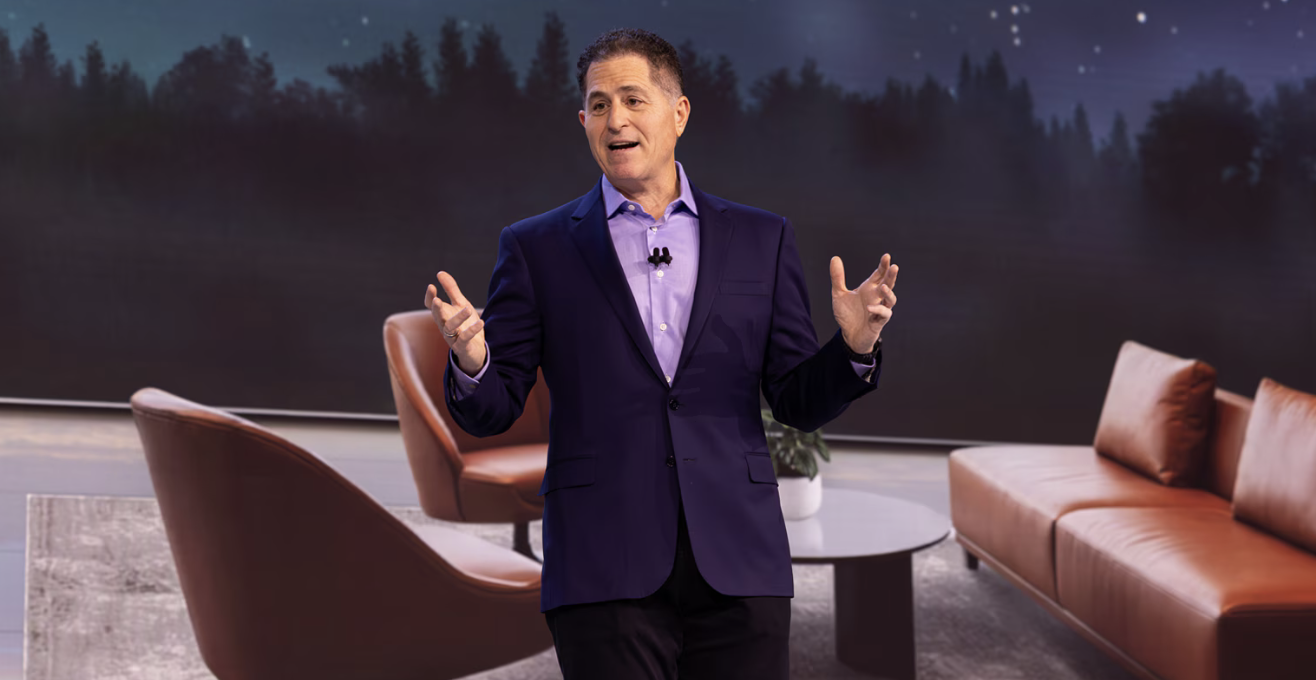
At Dell World 2026 in Las Vegas this week, chairman and CEO Micheal Dell framed this moment as a turning point. “AI is collapsing the cost and time to competitive advantage,” he said on May 18.
Business leaders are already acting on this shift. Organisations are using AI to innovate at speed, deploying applications faster and rolling out new solutions rapidly to stay ahead.
Dell described AI not just as another software layer, but as a new form of infrastructure, one where intelligence itself becomes a core economic output.
Yet, even as adoption accelerates, enterprises are under pressure. Data is still siloed and inferencing costs are spiralling. While the cost per tokens – the units of text processed during inferencing – is falling, overall usage is surging. Enterprises are still burning far more tokens leading to skyrocketing cloud bills.
This is particularly acute for agentic AI workloads, where inferencing is continuous. Each prompt consumes compute, memory, energy, and GPU resources.
There have been reports where a single developer burned through one billion tokens in 24 hours leading to a US$3,400 cloud bill.
Against this backdrop, hybrid AI computing is becoming more attractive to contain costs. According to a recent Dell survey on AI adoption, about 67 per cent of AI workloads already run outside the cloud, either on-premises, on device at the edge or in a co-location data centre.
Notably, 87 per cent of respondents are running at least one AI workload on-premise. Dell’s product announcements at this year’s event reflect this shift toward hybrid and distributed AI infrastructure.
The company unveiled a new generation of more powerful workstations and servers, many built on Nvidia graphics processing unit (GPU) platforms and designed to support increasingly demanding AI workloads while managing inferencing costs more effectively.
More powerful workstations and servers
The new product announcements are around the Dell AI Factory, PowerRack, Deskside Agentic AI and private cloud architectures. Together they aim to help organisations move agentic AI from experimentation into production, spanning environments from desktop to data centre.
One key capability is local development and deployment. Organisations can build, test, finetune and run AI agents directly on high-performance workstations, reducing reliance on cloud infrastructure and ensuring sensitive data does not leave the environment.
Organisations can choose to run the frontier models of their choice. Dell is also working closely with Nvidia. Its offerings combine Dell’s workstations with Nvidia NeMo Claw, allowing enterprises to build, test, and run autonomous agents locally.
With this solution, Dell claims that enterprises’ sensitive data never leaves the building, and the variable cloud token costs are converted into a fixed, predictable hardware investment.
Alongside the hardware, the company introduced updates focussed on cybersecurity and cyber resilience. It expanded its PowerProtect lineup which strengthens cyber recovery and ransomware resilience while enhancements to PowerScale storage improve detection and response for AI datasets, vector databases and inferencing systems.
Looking ahead, Dell is also preparing for emerging risks. It announced quantum-ready protections for commercial PCs, including stronger BIOS verification and firmware validation mechanisms designed to resist future quantum-enabled attacks.
This year’s Dell World event, which showcases the company’s various products, attracted 8,000 people to the Sands Convention Centre in Las Vegas. The company aims to tap on the worldwide AI infrastructure spending that could hit US$3 trillion to US$4 trillion by 2030, according to Nvidia’s estimates.
Some other products unveiled at Dell World 2026 include:
- Dell Desk-Side Agentic AI, an on-premises infrastructure solution that allows businesses to run autonomous, multi-step AI agents directly on high-performance workstations.
- Nvidia OpenShell, a secure runtime environment that acts as a governed sandbox for agents, scaling from desktop systems to data centre servers.
- Dell-Nvidia AI-Q 2.0 Reference Architecture which connect a production-ready framework for multi-agent workflows, tailored for compliance-heavy industries.
- Nvidia Omniverse libraries which link product lifecycle management systems directly into digital twins, for training physical AI models using real-world data.
- Data Analytics Engine (powered by Starburst) delivering GPU-accelerated SQL analytics on Nvidia Blackwell GPUs, with up to six times faster query performance.
- ObjectScale X7700, an ultra-dense appliance offering 45 per cent more hard disk capacity than its predecessor.
- Dell PowerRack is a single factory-integrated system, designed to handle large scale AI workloads with optimised thermal design and power management, managed via the Dell Integrated Rack Controller.