In association with Anker
For 80 years, every chip ever built has moved data back and forth between memory and processor – consuming more than 90 percent of available power before a single calculation begins. At Anker Day in New York today, Anker Innovations announced it has ended that for consumer hardware.
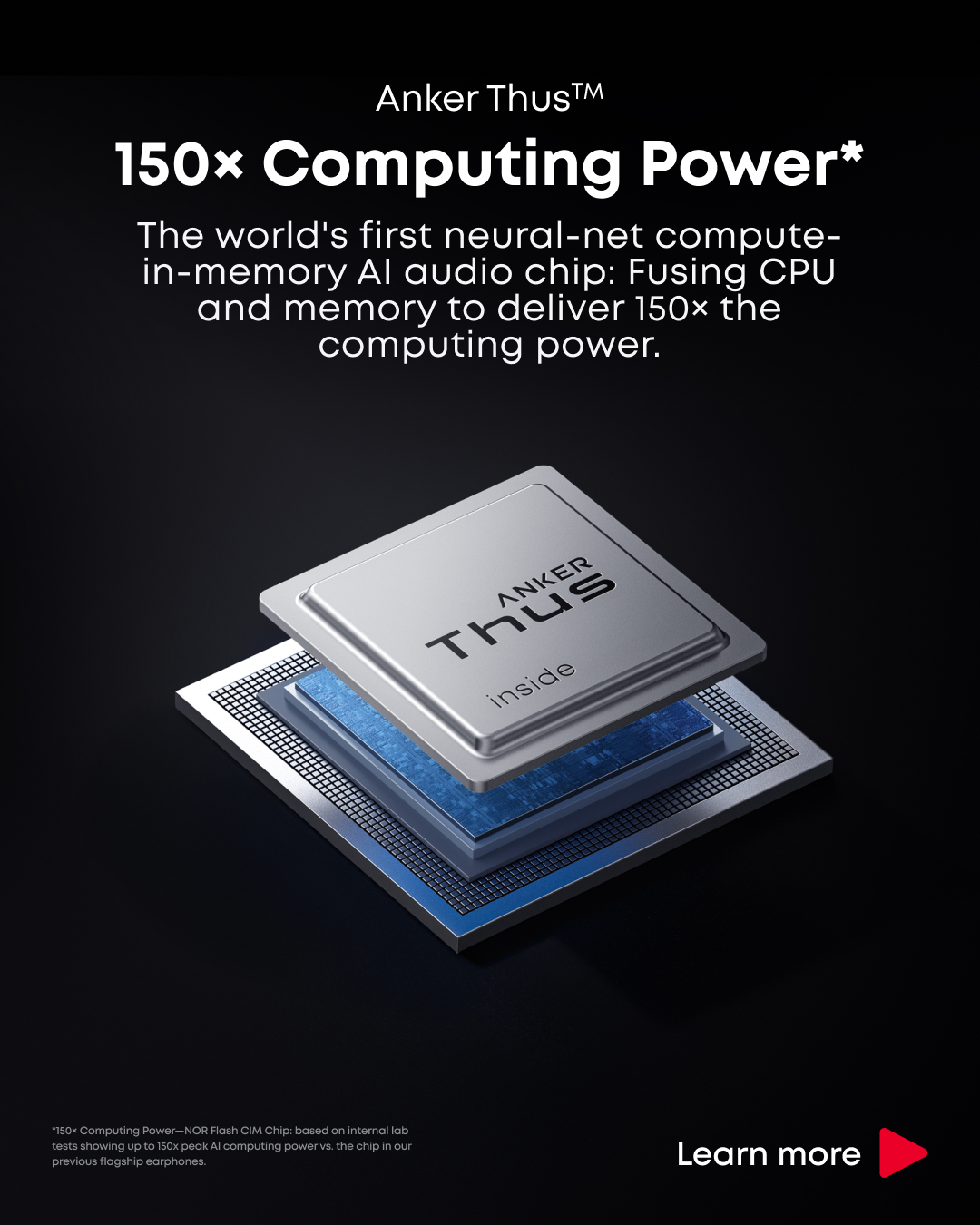
Thus, the company’s first proprietary AI chip, computes directly inside NOR Flash memory, eliminating the transfer entirely – a neural-net compute-in-memory (CIM) architecture the company says is the first ever commercialised in a consumer device.
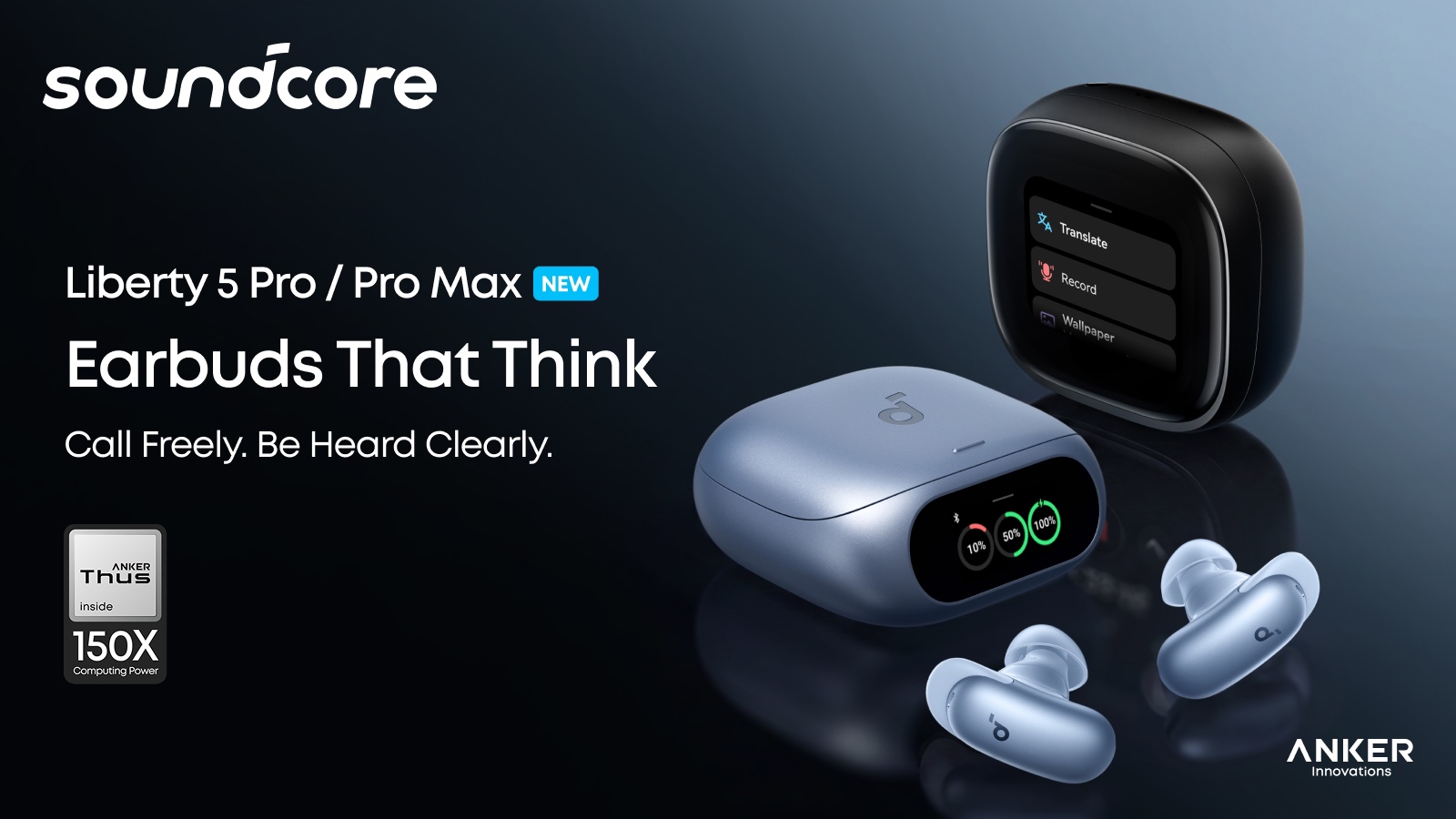
The product carrying it, the soundcore Liberty 5 Pro and Pro Max, has already earned a Guinness World Records certification for the highest objectively measured speech quality score in TWS earbud history. Anker calls them Earbuds That Think.
THUS: Breaking an 80-year assumption in chip design
Every chip built today descends from an architecture established in 1945 by mathematician John von Neumann. Its defining logic was divide and conquer: break any problem into discrete steps, translate those steps into code, and execute them one at a time.
Memory and the processor can therefore be physically separated. Programs live in memory; the CPU fetches one instruction at a time, executes it and advances to the next.
AI breaks that assumption entirely. A neural network does not divide a problem into steps – it processes end-to-end, drawing on millions or billions of learned parameters all at once. Every inference requires every one of those parameters to make the round trip between memory and the processor.
In a data centre, that movement is an engineering cost. In a wearable device that is powered by a battery smaller than a fingernail, it is a wall: more than 90 percent of chip power is consumed by simply moving data.
Introducing THUS AI chip platform
The answer has long existed in nature. Neurons in the human brain do not separate where information is stored from where it is processed – they do both in the same place. THUS applies that same principle to silicon.
Rather than shuttling model parameters between physically separate memory and processor, THUS embeds computation directly inside NOR Flash memory cells. The model parameters never have to move.
The energy previously consumed by that movement is redirected to actual computation. NOR Flash-based compute-in-memory also requires approximately one-sixth the physical footprint of SRAM-based alternatives, making it viable for the most constrained consumer devices.
“Every AI chip built until now stores the model on one side and does the computation on the other,” said Steven Yang, co-founder and CEO of Anker Innovations.
“To think, the device has to carry all those parameters across, many times per second, every single inference,” he added. “THUS puts the computation where the model already lives. The model never has to move again.”
Earbuds that think: The first consumer products to run THUS CIM AI
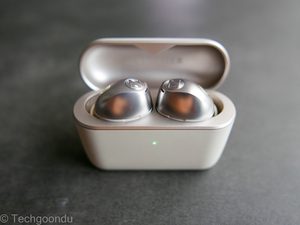
The soundcore Liberty 5 Pro and Liberty 5 Pro Max are the first two products to ship with the THUS chip. Their positioning is organised around three on-device intelligence layers the chip enables – understanding, adapting, and tuning – each representing a function earbuds could not credibly perform before neural-net AI became viable at this scale.
It understands: Call freely, be heard clearly, take proper notes
In April 2026, the soundcore Liberty 5 Pro earned Guinness World Records certification for the “Highest speech quality score (G-MOS) for TWS earbuds” in objective testing – the measurable proof of what it means for an earbud to truly understand its speaker.
The Liberty 5 Pro Max features identical earbud hardware and achieves equivalent call performance. Behind that result is a system built differently from the ground up. Conventional earbuds rely on microphone arrays alone to separate voice from noise – a process where both signals share the same medium (air), making clean isolation increasingly difficult as the acoustic environment grows louder or more complex.
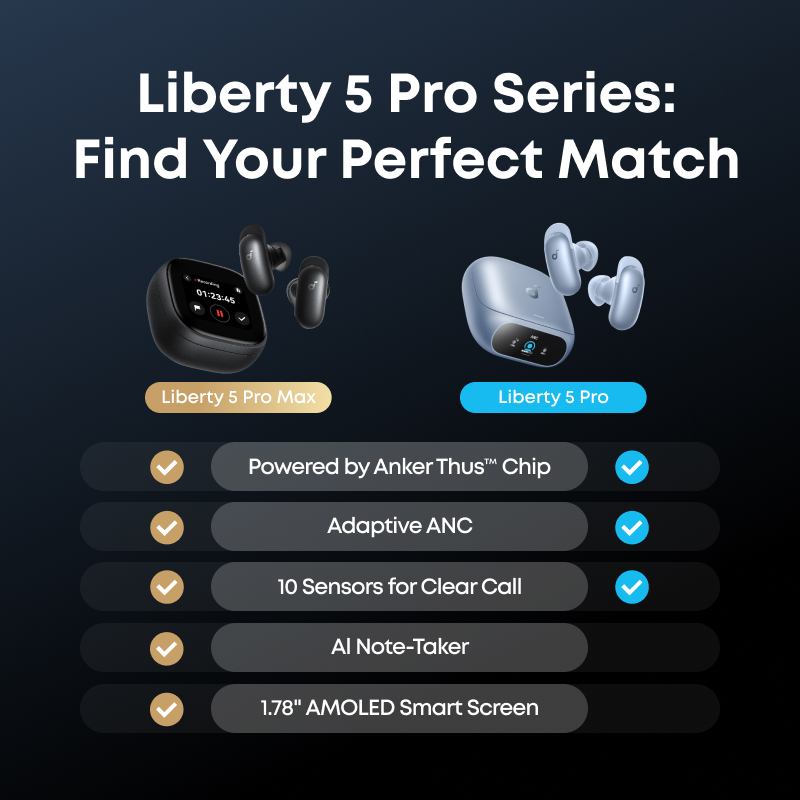
The Liberty 5 Pro and Liberty 5 Pro Max deploy a 10-sensor matrix – eight MEMS microphones and two bone conduction sensors – feeding a large neural-net model running entirely on-device via the THUS chip.
The MEMS array captures the full acoustic environment; the bone conduction sensors simultaneously detect the mechanical vibration of the speaker’s cranial bones – a signal physically coupled to the speaker’s voice and structurally independent of airborne noise.
The THUS chip cross-references both streams simultaneously, producing a far more precise isolation than microphone-only systems can achieve. Call Freely. Be Heard Clearly.
AI note-taker (Liberty 5 Pro Max)
The Liberty 5 Pro Max extends the understanding layer into meetings. Its charging case – operated through a 1.78-inch AMOLED display – records sessions without a connected phone, then generates transcripts, speaker identification, and action items via the soundcore
app.
The case’s 512MB of onboard flash supports up to 12 hours of local recording; cloud transcription deletes audio immediately upon completion, with local files encrypted via AES-256 and all transmission secured by TLS 1.3. Meetings end with plans, not messy notes.
It adapts: Instant focus, zero-pressure all day long
Adaptive ANC 4.0 monitors external and residual in-ear noise at 384,000 samples per second, adjusting cancellation depth in real time across noise types – low-frequency mechanical vibration, mid-frequency office ambient, high-frequency voice – while simultaneously managing the in-ear pressure that sustained fixed-level ANC typically generates, reducing listening fatigue over extended use. Rated at up to 2x deeper cancellation than the Liberty 4 Pro.
It tunes: Pure sound, just right
HearID 5.0 builds a personal EQ profile from an in-app hearing test. AI Sound Enhancement reconstructs frequency content lost in Bluetooth compression, restoring up to 65 per cent of the audio quality typically discarded in wireless transmission.
Both models support three-device Multipoint connectivity, Apple Find My, Google Fast Pair, IP55 dust and water resistance, Bluetooth 6.1. Battery: 6.5 hours with ANC on, 28 hours total with the charging case.