
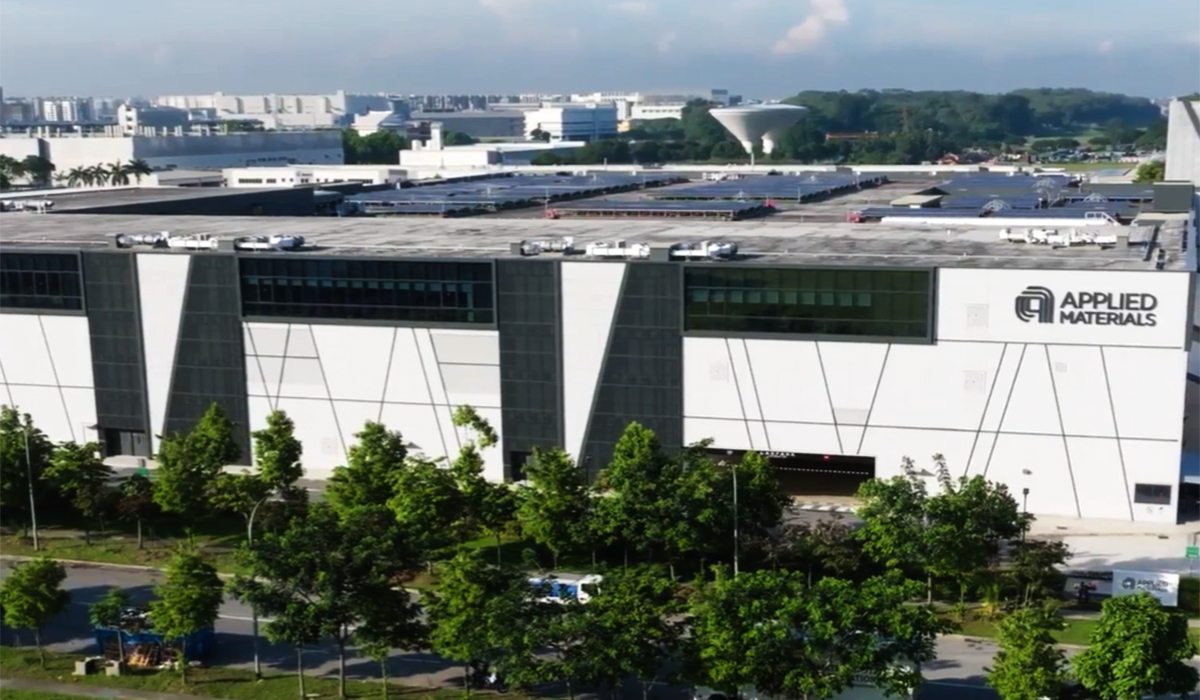
Applied Materials, a key equipment maker for today’s AI chipmakers, has opened a S$600 million campus in Singapore that will more than double its cleanroom capacity in the country to meet global demand.
It complements the company’s existing manufacturing facility in the United States, while also expanding its global footprint and diversifying its capabilities across the world.
The new facility in Tampines, in the northeast of Singapore, was planned for in 2022 and originally slated to open in 2024.
Before its official opening today by Deputy Prime Minister Gan Kim Yong, it has already been operating at volume capacity to serve chipmakers and meet AI-driven demand.
At a media tour of the cleanroom today, Applied Materials executives showed how it is using AI to check for potential defects, such as leaks, in equipment. This used to be handled manually.
It is also using autonomous vehicles to bring components to technicians, who make use of augmented reality glasses to guide their work, say, where they should tighten a screw on a machine.
A crucial member of the semiconductor industry, Applied Materials makes the machines that are used to produce the materials for advanced chipmaking today.
They are especially needed for today’s 3D chip designs, which “stack up” multiple dies to increase performance instead of using a single layer. To make such chips, different types of materials are needed, along with the expertise to pack them together.
Driven by the AI boom, Applied Materials just reported record quarterly revenues, with its highest gross margins in more than two decades.
Its customers include some of the world’s biggest manufacturers of processors and memory modules used in today’s AI servers and data centres.
The AI industry’s is trying to max out the number of tokens that can be delivered per second per watt, which is driving innovations like advanced chip packaging, said Applied Materials president and chief executive officer, Gary Dickerson.
The race to meet AI commute demand will lead to more die stacking and larger packages with more substrate, as chipmakers stack more material into each chip and try to move data at higher speeds, he noted.
On choosing Singapore to site the new plant, he paid tribute to the country’s “outstanding” culture and talent that make it ideal for growing the company’s capabilities.
Besides expanding manufacturing capacity, the new campus is expected to deepen research efforts and also broaden technology partnerships in a country that has attracted key semiconductor companies such as Micron to produce in-demand AI chips in recent years.
With the new plant’s opening, about 1,000 new local jobs are expected in the next few years, according to Applied Materials, which has been in Singapore for 35 years.
The company today also announced new partnerships with two universities here – the National University of Singapore and Singapore Institute of Technology – to advance talent training and semiconductor research.